
What Does Gorilla Trekking in Uganda Really Feel Like?
what does Gorilla trekking in Uganda really feel like?, Gorilla trekking in Uganda is not simply another wildlife activity.
It is an experience that takes you deep into an ancient rainforest, across steep trails and beneath towering trees, until you finally come face-to-face with one of the world’s most remarkable primates: the mountain gorilla.
You may arrive in Uganda expecting a great wildlife adventure.
But many travelers discover that gorilla trekking in Uganda feels much more personal and emotional than they imagined.
There is the excitement of walking through Bwindi Impenetrable Forest.
There is the anticipation when your guide tells you that gorillas are nearby.
There is the sound of branches moving somewhere in the vegetation. Then, suddenly, you see a gorilla looking back at you.
For many travelers, that moment becomes the highlight of their Uganda safari.
Uganda offers gorilla trekking in Bwindi Impenetrable National Park and Mgahinga Gorilla National Park.
Bwindi is divided into four main trekking sectors: Buhoma, Ruhija, Rushaga and Nkuringo. Uganda Wildlife Authority says a gorilla trek can last approximately 2 to 7 hours, depending on the location and movement of the gorilla family you are tracking. Once you find the habituated gorillas, visitors are allowed a limited observation period.
So, what does gorilla trekking in Uganda really feel like?
Let’s take you through the experience.
The Morning Starts With Excitement
Your gorilla trekking day normally starts early.
You wake up at your lodge surrounded by the sounds of the forest, mountains and nearby communities. Breakfast comes early because the trekking briefing begins before you enter the forest.
There is a feeling of anticipation.
You know that somewhere in the rainforest, a gorilla family is waiting.
At the briefing point, your guide explains the trekking procedures, safety guidelines and what to expect in the forest. You then begin your walk with trained guides and trackers.
This is when the adventure truly begins.
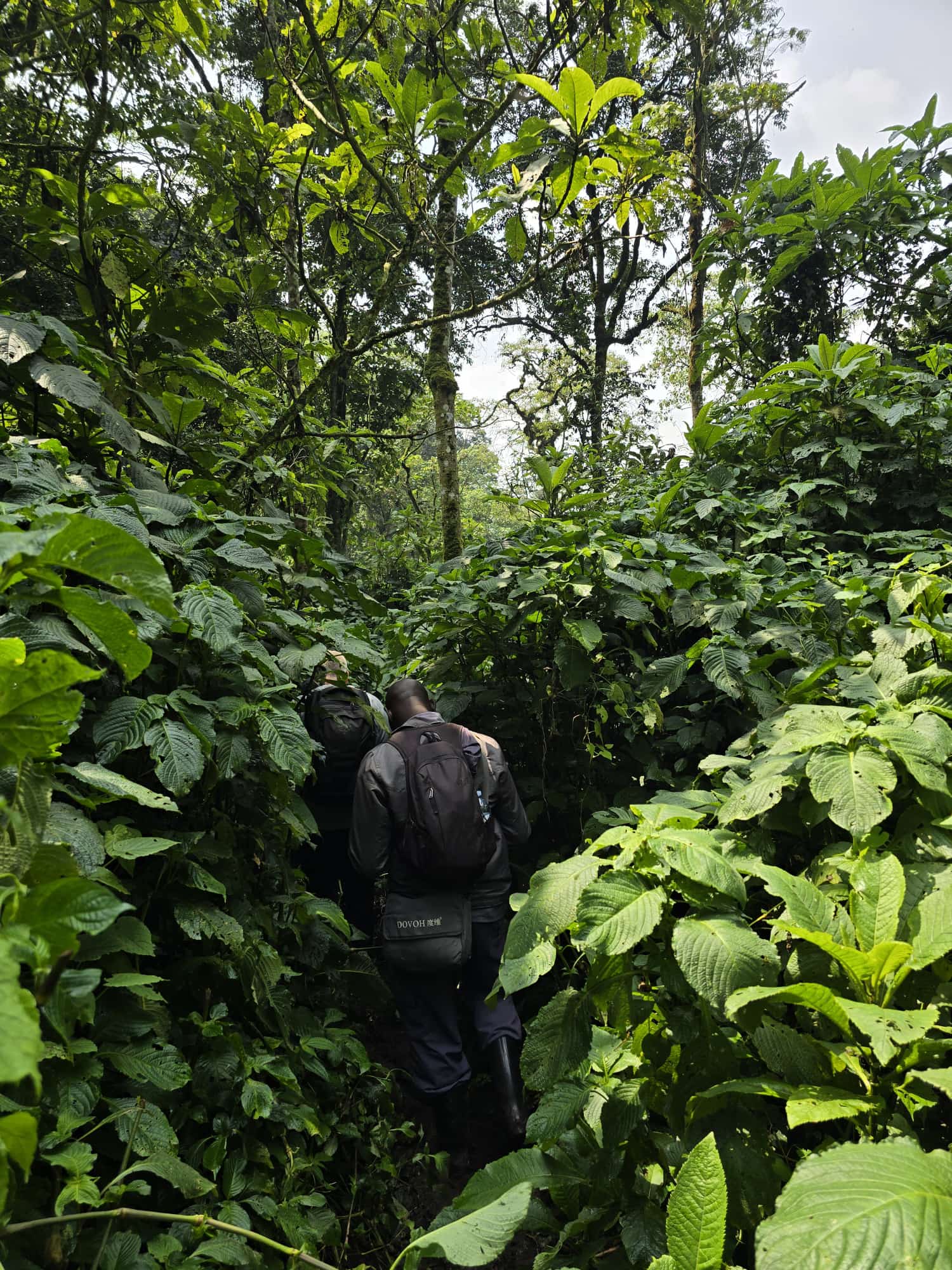
Walking Into Bwindi’s Ancient Rainforest
The first thing you notice is the forest.
Bwindi Impenetrable National Park is not an ordinary woodland. It is a mountainous rainforest with thick vegetation, steep slopes, valleys and muddy trails.
The forest can feel mysterious.
You hear birds calling from the canopy. You may see butterflies moving through the vegetation. Your guide points out plants, animal signs and sounds that you might otherwise miss.
The deeper you walk, the more disconnected you feel from the outside world.
Your phone may be in your pocket, but your attention is completely somewhere else.
You are listening.
You are watching.
You are searching.
You are experiencing the forest.
Uganda Wildlife Authority describes Bwindi as one of Uganda’s major gorilla destinations and notes that the park contains a significant portion of the world’s mountain gorilla population.
Is Gorilla Trekking in Uganda Difficult?
This is one of the most common questions travelers ask.
The honest answer is: it can be physically demanding, but the difficulty varies.
Gorilla trekking takes place in mountainous forest terrain. You may walk uphill, downhill, through thick vegetation and across muddy or slippery sections.
Some travelers find the trek relatively easy.
Others find it challenging.
Your experience depends on your fitness, weather conditions, terrain and where the gorilla family has moved.
Uganda Wildlife Authority recommends moderate fitness because gorilla tracking may take several hours.
That does not mean you need to be an athlete.
You should simply prepare for walking.
Comfortable hiking shoes, lightweight clothing, rain protection, water and a reasonable level of fitness can make a major difference.
If you are concerned about the physical challenge, tell your World Blossom Safaris safari planner before your trip. We can help you choose an itinerary and trekking sector that suit your circumstances.
Then Comes the Moment You Have Been Waiting For
After walking for perhaps one hour, three hours or longer, your tracker may suddenly stop.
The atmosphere changes.
Your guide becomes quieter.
You may hear branches breaking.
You may see fresh signs of gorilla activity.
Then your guide points into the vegetation.
There they are.
A gorilla family.
For a few seconds, you may simply stand there trying to understand what you are seeing.
A silverback could be sitting nearby.
A mother may be caring for her baby.
Young gorillas may be playing in the vegetation.
Another gorilla may be feeding quietly.
And sometimes a gorilla may look directly at you.
That is the moment many visitors describe as unforgettable.
What Does It Feel Like to Stand Near a Mountain Gorilla?
It is difficult to explain the feeling accurately until you experience it yourself.
Mountain gorillas are enormous compared with humans, yet their behavior can appear remarkably calm and natural when visitors follow the established rules.
You are not watching them through a vehicle window.
You are standing in their forest.
You can hear them moving through vegetation.
You can see their expressions.
You can watch family members interact.
You begin to realize that this is not a performance created for tourists.
This is their home.
You are a visitor.
That realization is one of the most powerful parts of gorilla trekking in Uganda.
The Silverback Is Often the Center of Attention
For many first-time visitors, the silverback is the animal they most want to see.
A mature male mountain gorilla can be incredibly impressive.
The size.
The strength.
The presence.
But one of the most interesting parts of observing a gorilla family is seeing the relationships within the group.
You may watch a silverback resting while younger gorillas play nearby.
You may see mothers caring for infants.
You may see juveniles climbing and exploring.
You may also see gorillas feeding quietly, completely uninterested in the humans standing nearby.
Every trek is different.
That unpredictability is part of what makes the experience special.
You Are Not Guaranteed a Perfect Photo
One thing travelers should understand before gorilla trekking in Uganda is that this is a wildlife experience, not a staged photography session.
Gorillas live naturally in dense forest.
They may be partially hidden by vegetation.
The light can change quickly.
A gorilla may move just as you prepare to take a photograph.
Sometimes the best memory is not the photograph.
It is the moment itself.
Uganda’s gorilla tracking guidelines also prohibit flash photography and require visitors to maintain the prescribed distance from gorillas.
The One-Hour Gorilla Encounter
Finding the gorillas is only part of the experience.
Once you reach the habituated gorilla family, visitors are given a limited period to observe them.
Current Uganda Wildlife Authority guidance states that visits are limited to one hour per gorilla group per day, helping protect the animals and regulate human interaction.
One hour may sound like a long time before your trek.
When you are actually standing beside a gorilla family, it can feel incredibly short.
You suddenly wish you had more time.
You watch one gorilla.
Then another.
Then the silverback moves.
A baby appears.
Someone laughs quietly.
A gorilla walks past.
You look at your watch.
The hour is almost finished.
Then it is time to leave.
You May Feel Emotional
Many travelers expect excitement.
They do not always expect emotion.
Standing in the forest with mountain gorillas can create a sense of connection with nature that is difficult to describe.
You may think about how rare these animals are.
You may think about the effort involved in protecting their habitat.
You may think about the generations of people and conservationists who have worked to protect gorillas.
And you may realize that your visit is part of a larger conservation story.
Uganda Wildlife Authority reports that Bwindi’s mountain gorilla population increased from historically low levels, with 459 individuals recorded in the 2018 census; UWA says updated 2025/26 genetic analysis results are still awaited.
That conservation story is one reason responsible gorilla tourism matters.
Gorilla Trekking Is Also About the People
Your experience does not begin and end with the gorillas.
There are guides.
Trackers.
Park staff.
Porters.
Lodge employees.
Drivers.
Local communities.
All contribute to the experience.
A knowledgeable guide can transform a walk through the forest into a fascinating lesson about wildlife, plants, birds, conservation and local history.
At World Blossom Safaris, we believe your safari should not feel like simply moving from one destination to another.
We want travelers to understand Uganda.
To meet people.
To experience communities.
To see wildlife.
And to return home with memories that go beyond photographs.
Which Gorilla Trekking Sector Should You Choose?
Uganda’s main Bwindi trekking sectors include:
- Buhoma
- Ruhija
- Rushaga
- Nkuringo
There is also Mgahinga Gorilla National Park, located in Uganda’s Virunga mountain region.
Each area has different landscapes, accommodation options, access routes and trekking characteristics.
That is why choosing a gorilla permit should not be based only on the name of the park.
Your overall itinerary matters.
For example, if your Uganda safari also includes Kibale Forest, Queen Elizabeth National Park and Bwindi, the most practical trekking sector can depend on your route and accommodation.
A professional Uganda tour operator can help match the trekking sector with your wider itinerary.
What If It Rains?
Welcome to a rainforest.
Rain is part of the experience.
Bwindi can be wet, and conditions can change quickly.
You might begin your trek under cloudy skies and later experience sunshine.
Or you might walk through rain for part of the trek.
This is why proper preparation matters.
Pack:
- Waterproof hiking shoes
- Lightweight rain jacket
- Long trousers
- Long-sleeved shirt
- Water
- Snacks
- Insect repellent
- Small backpack
- Camera with protection from rain
- Walking poles if needed
- Gardening gloves for difficult vegetation
Do not let the possibility of rain discourage you.
A wet forest can actually make the experience even more atmospheric.
What Happens If You Are Tired?
Tell your guide.
Do not try to prove that you can continue when you need a break.
Your guide and trekking team are there to help.
You can walk at a manageable pace and take breaks when appropriate.
For travelers who are worried about the physical challenge, planning ahead is important.
Discuss your fitness level with your tour operator before confirming your itinerary.
Can Older Travelers Go Gorilla Trekking in Uganda?
Age alone does not determine whether someone can enjoy the experience.
Fitness, mobility and preparation matter.
However, Uganda’s current gorilla tracking rules specify a minimum age of 15 years.
If you are an older traveler or have mobility concerns, discuss your situation with your safari operator before booking.
The goal is to prepare an itinerary that is realistic and comfortable for you.
What Should You Wear for Gorilla Trekking?
The forest is not a place for fashion.
Comfort and protection come first.
Wear:
Long trousers:
They help protect your legs from vegetation and insects.
Long-sleeved shirt:
Useful for protection against vegetation and insects.
Strong hiking shoes:
Trails can be muddy, steep and slippery.
Rain jacket:
Rain can arrive unexpectedly.
Gardening gloves:
These can be useful when moving through vegetation.
Gaiters:
Helpful in wet and muddy conditions.
Hat:
Useful for sun and rain protection.
Your clothing should allow you to walk comfortably for several hours.
Is Gorilla Trekking Safe?
Gorilla trekking is a regulated wildlife activity.
Visitors trek with authorized guides and follow established conservation rules.
UWA‘s current guidance requires visitors to maintain a prescribed distance from gorillas, limits the number of visitors per gorilla group and restricts the duration of visits. Visitors who are sick with contagious illnesses should not visit the gorillas because human diseases can affect them.
The rules are not there to make the experience less enjoyable.
They help protect both people and gorillas.
Why Gorilla Trekking in Uganda Is Different
There are several reasons travelers choose Uganda.
First, Uganda offers gorilla trekking in two national parks: Bwindi Impenetrable National Park and Mgahinga Gorilla National Park.
Second, Uganda allows travelers to combine gorilla trekking with a much broader safari experience.
You can begin with chimpanzees in Kibale.
Continue to Queen Elizabeth National Park for wildlife.
Then travel toward Bwindi for gorilla trekking.
You can add Lake Mburo, Murchison Falls, Kidepo Valley, Rwenzori or cultural experiences depending on your available time.
This makes it possible to build a complete Uganda safari rather than a trip focused only on gorillas.
What Is the Best Part of Gorilla Trekking in Uganda?
There is no single answer.
For some travelers, it is the first sight of a silverback.
For others, it is seeing a baby gorilla.
Some remember the forest itself.
Others remember the guides and trackers.
Some remember the silence immediately before finding the family.
But perhaps the most powerful part is this:
You are entering the natural home of mountain gorillas and observing them without controlling what happens next.
That makes every trek different.
What Happens After the Trek?
When the trek ends, you walk back toward the starting point.
You may be tired.
Your shoes may be muddy.
Your clothes may be wet.
But you are likely to be smiling.
Many travelers find themselves talking about the gorillas all the way back to the lodge.
You may look at your photographs.
You may compare memories with other travelers.
And you may already be thinking about returning to Uganda.
That is the beauty of a great wildlife experience.
It stays with you.
How Much Does Gorilla Trekking in Uganda Cost?
The total cost of a Uganda gorilla trekking safari depends on several factors.
Your final price can include:
- Gorilla permit
- Accommodation
- Transport
- Driver-guide
- Meals
- Park fees
- Airport transfers
- Number of travelers
- Safari duration
- Accommodation category
- Additional activities
A short gorilla safari will naturally cost differently from a longer Uganda wildlife and gorilla safari.
Instead of choosing a package based only on the lowest advertised price, ask what is actually included.
At World Blossom Safaris, we can create budget, mid-range and higher-end Uganda gorilla safari itineraries depending on your travel style.
How Far in Advance Should You Book Gorilla Trekking in Uganda?
Gorilla trekking permits are limited.
Because of this, travelers should plan ahead, especially when traveling during popular periods.
Your preferred date, trekking sector, accommodation and overall route can all affect availability.
UWA also provides specific guidance on the purchase and management of gorilla permits.
If your travel dates are flexible, tell us.
We can help you explore suitable dates and build the rest of your safari around your gorilla trekking experience.
Why Book Your Uganda Gorilla Trekking Safari With World Blossom Safaris?
Planning a gorilla safari involves more than buying a permit.
You need the right trekking sector.
You need suitable accommodation.
You need reliable transportation.
You need someone who understands the roads.
You need a professional guide.
And you need an itinerary that works as a complete journey.
World Blossom Safaris is a Uganda-based tour and travel company offering gorilla trekking, chimpanzee tracking, wildlife safaris and tailor-made Uganda adventures.
Our goal is simple:
To help you experience Uganda safely, comfortably and meaningfully.
Whether you are planning a short gorilla trekking trip or a longer Uganda safari, we can create an itinerary around your dates, interests and budget.
Your Gorilla Trekking Experience Starts With One Decision
Imagine waking up in southwestern Uganda.
You have breakfast.
Your hiking boots are ready.
Your camera is packed.
Your guide is waiting.
You enter the forest.
You walk deeper into the green.
You hear birds.
You hear branches moving.
Your tracker stops.
Everyone becomes quiet.
Then you see them.
A mountain gorilla is sitting only a short distance away.
For a moment, everything else disappears.
That is what gorilla trekking in Uganda can feel like.
Not just a safari.
Not just a hike.
Not just a photograph.
A moment you may remember for the rest of your life.
Ready to Experience Gorilla Trekking in Uganda?
If you are planning to see mountain gorillas in Uganda, World Blossom Safaris can organize your complete gorilla trekking safari from start to finish.
Tell us:
- Your preferred travel dates
- Number of travelers
- Your nationality
- Your approximate budget
- Preferred accommodation level
- Whether you also want chimpanzee tracking and wildlife safaris
We can then design a private Uganda gorilla safari around your interests.
Let us help you blossom to the Pearl of Africa.
Book your Uganda gorilla trekking safari with World Blossom Safaris and start planning your encounter with the mountain gorillas today.
Frequently Asked Questions About Gorilla Trekking in Uganda
How long does gorilla trekking in Uganda take?
The trek itself can take approximately 2 to 7 hours, depending on the movement and location of the gorilla family. Once you find the gorillas, the official observation period is limited.
Where can I go gorilla trekking in Uganda?
Gorilla trekking takes place in Bwindi Impenetrable National Park and Mgahinga Gorilla National Park.
Is gorilla trekking in Uganda difficult?
It can be physically demanding because the terrain is mountainous and forested. UWA recommends moderate fitness. The difficulty varies depending on the gorilla family’s location and the day’s trail conditions.
What age can you go gorilla trekking in Uganda?
Uganda’s current gorilla tracking rules specify a minimum age of 15 years.
How close can you get to gorillas in Uganda?
Current UWA guidance requires visitors to maintain a 10-metre distance from gorillas, subject to the official tracking guidelines.
How long can I stay with the gorillas?
The standard gorilla visit is limited to one hour per gorilla group per day.
Can I take photographs during gorilla trekking?
Yes, photography is permitted, but flash photography is not allowed. Follow your guide’s instructions and the park regulations.
What if it rains during my gorilla trek?
Rain is possible because Bwindi is a rainforest. Carry waterproof clothing and protect your camera and other equipment.
Do I need to be very fit for gorilla trekking?
You do not need to be an athlete, but you should be prepared for several hours of walking on uneven and sometimes steep terrain.
Is gorilla trekking in Uganda worth adding to a safari?
For travelers interested in mountain gorillas and rainforest wildlife, it can be a major part of a Uganda safari. The experience can also be combined with chimpanzee tracking and traditional wildlife safaris.
Ready to plan your trip? Talk to our experts.
Book This Safari

[…] Gorilla Trekking: The highlight of any visit, gorilla trekking offers a once-in-a-lifetime opportunity to observe mountain gorillas in their natural habitat. […]